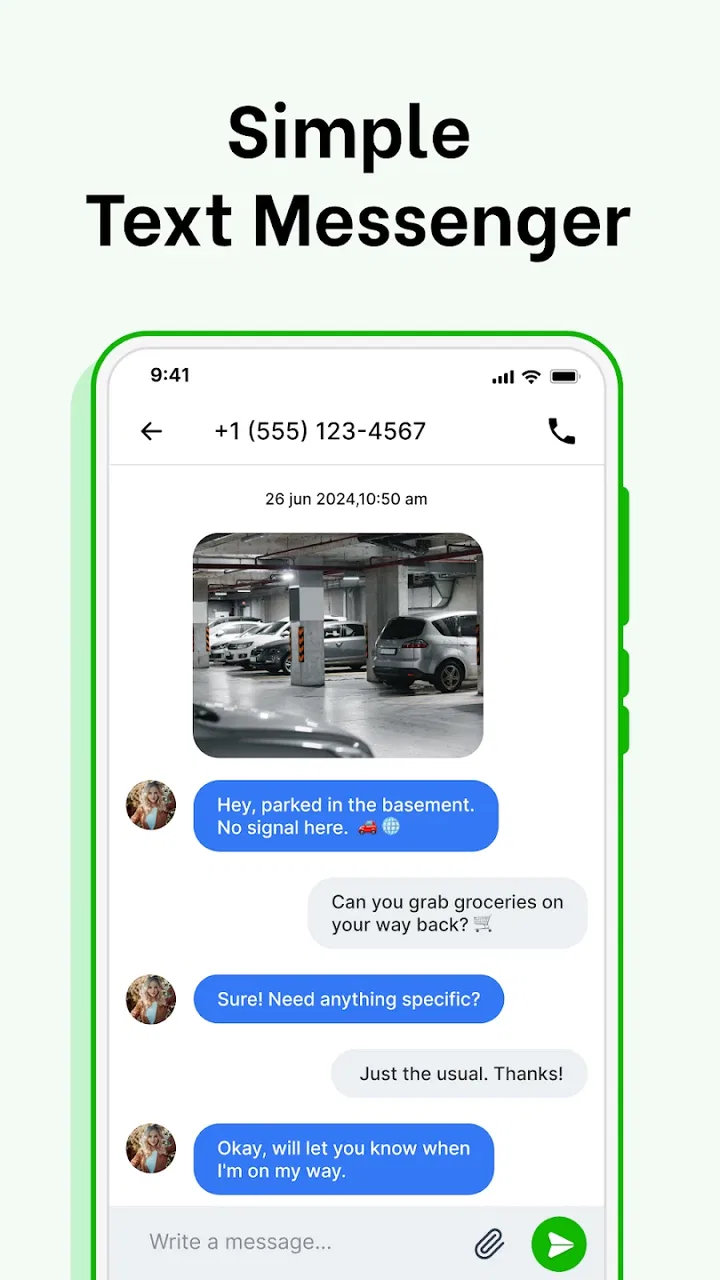
Messages: SMS, Messenger Home
- 3.7
- Rating
- 1.00M
- Installs
- Free
- Price

 Analysis by App-foxy
Messages: SMS, Messenger Home is a communication app from Apps Specials that puts access to text messages and SMS on a simple home screen. I approached it less like a replacement for every messaging service and more like a focused doorway to the conversations already handled by a phone’s text-message system. That distinction matters, especially in a household where one device may be used by different people at different moments.
My first impression was that the app’s appeal comes from reducing the distance between unlocking a phone and reaching SMS conversations. There is no promise here of becoming a complete social platform, and that is actually useful. If your everyday communication still depends on ordinary text messages, a direct home-screen experience can feel more practical than opening a broad communication app filled with unrelated features.
The app is free to install and is rated for Everyone, which makes it easy to consider for a general household device. It has reached over a million installs and holds an average rating of 3.9 from around five thousand ratings, so it has attracted a sizeable audience while still leaving room for mixed experiences. I would treat that rating as a sign to test the app personally rather than assume it will suit every phone or every family routine.
You May Also Like

 Blood Strike: 2.5 Anniversary
Blood Strike’s Loadouts Turn Every Drop Into a Tactical Gamble
A close look at Blood Strike’s custom loadouts: how fast access to signature weapons reshapes its battle royale rhythm, rewards preparation, and narrows the gap between fights.

 Pandora - Music & Podcasts
Pandora’s Music Is Easy to Start, but Harder to Recover
Pandora’s strength is its low-effort path from a seed to a station. Its weak spot is how much confidence it asks you to place in connection, setup, and quiet recovery.

 8 Ball Pool
 Is Built on Rivalries, Rematches, and Routine
A close look at the rivalries, rematches, shared routines, and unanswered safety questions that turn a quick pool match into a persistent mobile community.

 Samsung Music
’s Quiet Strength Is Playing What You Already Own
Its reach comes less from spectacle than from dependable access to a personal library. That simplicity is both the app’s strongest retention engine and its ceiling.

 AccuWeather: Weather Radar
AccuWeather Review: A Quick, Clear Forecast for Everyday Decisions
For everyday plans, the best forecast is the one you can understand quickly. AccuWeather makes rain timing, radar, and local conditions easy to act on, with a few trade-offs.

 Hill Climb Racing
Why Hill Climb Racing Still Turns Crashes Into One More Run
A tiny car, a bumpy hill and one more upgrade: Hill Climb Racing keeps resurfacing because its simple chaos makes every near-miss feel personal.
More From Our News Desk



How it fits a shared household phone
The clearest use case is a phone that is passed between people or kept in a common area for practical communication. Imagine a household phone used to receive delivery updates, appointment reminders, school notices, or messages from relatives. With a home-screen route to SMS, the person picking up the device does not need to search through several communication tools just to find a text.
That convenience has a boundary: the app does not turn a shared phone into separate personal spaces. Anyone who can use the device may still encounter the same message environment that the phone makes available. I would therefore use it on a household device only when the people sharing that device already agree about message visibility. It is helpful for coordination, but it should not be mistaken for a privacy layer.
For a family coordinating ordinary errands, the focused design can be more useful than a full-featured messenger. One person can check whether a pickup message arrived, another can look for a confirmation code, and someone else can respond to a relative without navigating a large social inbox. The trade-off is that SMS remains SMS: the experience is tied to the phone’s text-message workflow rather than becoming a universal inbox for every chat service.
A realistic example is a parent leaving a phone at home while a teenager waits for a courier or a family member’s arrival message. The home-screen access makes the relevant text easier to reach, but I would still establish a simple household rule: do not open conversations that are not meant for you, and do not assume that a visible notification is permission to read the entire thread. The app can simplify access; it cannot create trust between users.
What the home-screen approach changes
Traditional messaging apps often make users move through an app drawer, a folder, or a broader dashboard. This app’s emphasis is narrower. Its value is strongest when the task is already known: check SMS, reply to a text, or return to an existing conversation. That makes it a reasonable choice for someone who finds a standard messaging route unnecessarily buried.
I also found that this kind of shortcut changes the rhythm of checking messages. Instead of opening a general-purpose communication service and being drawn into other sections, I can go straight to the text-message task. For a shared device, that narrower path may reduce accidental wandering through unrelated accounts or apps, although it does not remove the need to check which conversation is open before replying.
The limitation is equally clear. People who mainly communicate through internet-based chats, group platforms, or social networks may see little benefit. The app’s purpose is centered on SMS access, so it is not the right answer for someone looking for one combined place for every conversation. In that situation, the phone’s established messaging tools or a broader communication platform may be a better fit.
Setting boundaries before anyone shares the phone
Before putting this app on a common device, I would decide who the phone is actually for. That sounds obvious, but it affects whether the app feels convenient or intrusive. A household phone used for shared logistics has different expectations from a personal phone temporarily handed to another person. The home-screen design works best when the device’s role is clear.
I would also separate the idea of easy access from the idea of unrestricted access. A shortcut to SMS is useful when several people need to coordinate, but it also makes conversations easier to reach. If the device contains personal messages, financial alerts, medical reminders, or private conversations, I would not treat a simple home-screen arrangement as sufficient protection. The app should support an agreed workflow, not replace one.
One practical habit is to decide who handles replies for shared numbers. If several people answer the same phone, a conversation can become confusing when one person assumes another has already responded. I would recommend saying aloud when an important message has been handled, especially for appointments, deliveries, or time-sensitive family plans. The app can make the message visible; the household still needs a human system for ownership.
Another useful boundary is to avoid using the shared phone as a storage place for every private exchange. If a conversation belongs to one individual, that person’s own device is generally more appropriate. This is not a criticism of the app specifically. It is a consequence of putting a communication entry point on a device that more than one person can pick up.
The developer is Apps Specials, and the current version is 2.4.6. The app requires Android 10 or newer, so compatibility should be checked before planning a household setup around it. That requirement is especially relevant for an older spare phone, since a device can be physically suitable for shared use while still running an operating system that cannot support the app.
A simple setup routine for shared use
I would begin with the least sensitive phone available, install the app, and spend a few minutes checking how the existing SMS conversations appear. Before inviting other users to rely on it, I would send a harmless test message and confirm that the intended person knows where to find it and how to return to the main conversation view.
Next, I would agree on a small set of rules rather than writing a complicated policy. For example, one person handles delivery texts, another handles school-related messages, and everyone announces when an important reply has been sent. These rules are not app features, but they make the app’s simple access model much safer and more predictable in real use.
I would also check notifications in the context of the shared room. A message preview appearing where everyone can see it may be convenient for a household alert, but awkward for personal content. If the phone is kept in a public space, I would be cautious about what appears on the lock screen and would avoid assuming that visibility is harmless just because the app is rated for Everyone.
That age rating describes the app’s general suitability, not the maturity of every conversation that might arrive through SMS. A child may be able to use the interface easily, but the household should still decide which messages are appropriate to read, which replies require an adult, and whether the device should be used for personal communication at all. The interface can be simple without the social situation being simple.
Using it for household coordination
Where I think the app makes the strongest practical case is quick coordination. SMS is still useful for people who do not share the same chat service, for automated notifications, and for contacts who prefer ordinary texting. A home-screen route means the person responsible for checking those messages can get to them without treating the phone like a personal social hub.
For example, a household could use the device to monitor a repair appointment. One person checks the incoming message, another tells the person at home that the technician is on the way, and the reply is sent from the same familiar conversation. The workflow is simple, but the important detail is assigning responsibility. Without that, two people may reply at once or nobody may reply because each assumes someone else is watching.
I would not use the app as the only record for complex plans. SMS threads can become difficult to follow when several people are making arrangements, especially if replies are brief or spread across different conversations. For a detailed schedule, a shared calendar or a dedicated planning tool may be clearer. Messages: SMS, Messenger Home is better at opening the communication channel than organizing the entire household’s commitments.
There is also a subtle advantage in keeping SMS access separate from more distracting services. When I only need to check whether a confirmation arrived, a focused route can help me finish that task without drifting into feeds, media, or unrelated chats. That is a genuine benefit for a household member who wants the phone to remain functional rather than entertaining.
On the other hand, people who need rich group collaboration may find the experience too limited. If your household depends on shared files, reactions, long-form planning, or synchronized task lists, an ordinary SMS-centered workflow will feel basic. I would choose this app for direct text coordination, not as a substitute for a complete family organization system.
Where it is better than the usual alternatives
Compared with opening the phone’s standard SMS app through the normal app list, the main advantage is directness. The app gives the messaging task a more prominent place in the phone experience. That can help an older relative or an occasional user who does not remember where the messaging app is located.
Compared with internet messaging platforms, it has a different strength: it stays focused on text messages rather than requiring everyone to join the same service. That can be useful for mixed households where relatives, schools, businesses, or service providers communicate through ordinary SMS. The downside is that it does not solve the limitations of SMS itself, so it may feel less capable than a modern chat service for active group conversations.
Compared with a full launcher or a heavily customized home screen, this approach is more specialized. Someone who wants to redesign the whole phone may prefer a broader tool with controls over many apps. Someone who simply wants SMS close at hand may appreciate not having to rebuild the entire interface. I see that narrow focus as the app’s identity rather than a missing ambition.
The free entry point makes trying it straightforward, but the app includes in-app purchases ranging from $6.99 to $25.99 per item. I would not make a purchase before using the basic experience in the exact household situation I care about. For a shared device, the important question is whether the access pattern is genuinely clearer and more comfortable, not whether extra spending adds value by default.
Age, trust, and the limits of simplicity
The Everyone rating may reassure households looking for a straightforward communication interface, but it should not be read as a guarantee that every incoming message is suitable for every user. SMS is an open channel in practical terms: messages can come from contacts, businesses, automated systems, or unknown senders. The app’s simple presentation does not change that reality.
For younger users, I would treat the app as part of a conversation about phone etiquette. They should know that opening a message on a shared device can expose someone else’s information, and that replying from a common number may create confusion. If an adult needs to approve certain replies, that expectation should be agreed before the phone is handed over.
For older relatives, the direct access may be genuinely helpful. A person who struggles to locate SMS in a crowded phone can benefit from seeing the communication route in a more obvious place. I would still walk through one complete cycle together: open a conversation, read the newest message, reply carefully, and return to the main view. Familiarity matters more than simply installing the app.
Trust also affects whether the app belongs on a personal phone. If the phone is yours alone and you already reach messages comfortably, the home-screen focus may not change much. If you often lend the device to family members, the convenience may come with more exposure than you want. In that case, keeping personal SMS on your own device and using a separate household phone is the cleaner arrangement.
One detail I would watch closely is the difference between a message being easy to find and a message being safe to act on. A delivery notice, payment alert, or urgent request may look convincing simply because it arrives in a familiar SMS thread. The app helps you access the message; it does not verify its legitimacy. I would still check senders and avoid treating a convenient interface as a security check.
Who should choose it, and who should skip it
I would recommend trying it if you want a dedicated, uncomplicated route to SMS, especially on a shared household phone where people need to check ordinary text messages without navigating a busy interface. It also makes sense for someone who prefers a focused communication entry point instead of a broad messaging environment.
I would skip it if your communication life is mostly built around internet chat services, if you need advanced organization for group plans, or if you are looking for separate profiles and strong privacy boundaries on one device. The app’s simplicity is useful only when your expectations match its narrow purpose.
I would also hesitate on an older spare phone until checking the Android requirement. A household setup is frustrating when everyone learns a new workflow and then discovers that the device cannot run it. Testing compatibility first is a small step that avoids building routines around an unsuitable handset.
My household verdict
After looking at it through the lens of shared use, I see Messages: SMS, Messenger Home as a focused convenience rather than a complete household communication solution. Its best quality is the straightforward path to text messages. That can remove a small but repeated annoyance: finding the right place to check an SMS when a phone is used by several people or by someone who prefers a simple home screen.
Its main weakness is that easier access also makes shared conversations easier to encounter. There are no grounds to treat the app as a substitute for separate accounts, private devices, or clear household agreements. If several people use the same phone, the boundaries must come from the people using it.
The app is free, aimed at Everyone, and maintained by Apps Specials, with a release history that includes the current version 2.4.6. Its rating of 3.9 suggests a generally workable experience with enough variation that I would test it on the actual phone and in the actual room where it will be used. The in-app purchase range also makes it sensible to evaluate the free experience before spending anything.
My final recommendation is conditional but positive: choose it for direct SMS access, shared errands, and households that value a calm, obvious communication route. Do not choose it expecting a unified inbox, private family profiles, or a planning system. The app works best when its simplicity is paired with deliberate household rules. In that setting, it can make everyday coordination easier without pretending to solve the trust and privacy questions that come with a shared device.
FAQs for Messages: SMS, Messenger Home
01What is Messages: SMS, Messenger Home?
Messages: SMS, Messenger Home is a versatile messaging app designed to enhance your SMS and MMS experience on Android devices. It offers a user-friendly interface, customizable themes, and advanced features like spam protection and message scheduling. The app aims to streamline communication by integrating various messaging services into one platform.
02How does Messages: SMS, Messenger Home enhance messaging functionality?
This app improves messaging by providing a cleaner, more intuitive interface compared to default SMS apps. It includes features such as message scheduling, quick reply from notifications, customizable themes, and a spam filter to block unwanted messages. These enhancements make managing conversations more efficient and enjoyable.
03Is Messages: SMS, Messenger Home safe to use?
Yes, Messages: SMS, Messenger Home is designed with user privacy and security in mind. It includes a robust spam filtering system and does not require unnecessary permissions. However, as with any app, it's important to download it from a trusted source like the Google Play Store to ensure you have the official version.
04Does Messages: SMS, Messenger Home support multimedia messages?
Absolutely, Messages: SMS, Messenger Home supports MMS, allowing users to send and receive photos, videos, and audio clips. The app ensures that media is sent quickly and efficiently, enhancing the overall communication experience. It also supports group messaging, making it easy to keep in touch with multiple contacts at once.
05Can I customize the appearance of Messages: SMS, Messenger Home?
Yes, customization is one of the key features of Messages: SMS, Messenger Home. Users can personalize the app with different themes, change font styles, and adjust chat bubble colors to suit their preferences. This level of customization allows users to create a unique messaging environment that reflects their individual style.
Pros
- User-friendly interface
- easy navigation.
- Customizable themes enhance personalization.
- Fast message delivery and syncing.
- Supports multimedia sharing seamlessly.
- Low data usage for efficient operation.
Cons
- Ads can be intrusive during use.
- Limited integration with other apps.
- Lacks advanced security features.
- No end-to-end encryption available.
- Some features require in-app purchases.

Messages: SMS, Messenger Home
Gallery